Domain B: Teaching
B1. Engaging learners
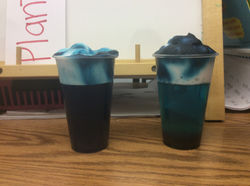
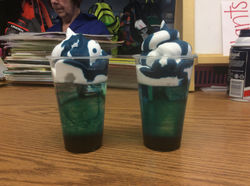
I think through the three lessons I have taught so far that I have effectively engaged all the students. There was only one case where one student did not want to do the writing prompt. However, this student sometimes gets incredibly frustrated with his writing and doesn't want to do it or asks to get help every step of the way through it. The rest of the students were very engaged the entire time. For my The Lorax lesson, they even came up with cool ways to make the Lorax cup their own - one student made it a puppet, which was very cool to see her get more involved in the task to make it her own, which is the picture included. I think there are definite ways to improve my classroom management, but in the little amount that I have taught the students, I feel good about what I have done to engage
them and keep them engaged.
So far, this fall, I have tried my hardest to keep all students engaged at all times. There have been times where this has been harder than others. There was a time when there was a sub, and a student fell asleep in class because he didn't want to move his clip down. Considering the circumstance and knowing that I was teaching all day, I didn't do much about the situation, but I really helped him the next day to understand what was going on in the lesson the day before. It was a focus of mine to make sure he would be engaged at some point, and while he wasn't perfectly engaged that day, he was engaged the next.
I took advice from my supervisor that has helped keep the kids more engaged throughout lessons. Cooperative learning techniques, such as centers, have really helped shape my teaching thus far. While I don't believe in grouping so much by ability unless necessary, I think that it's important to have students work together to teach other things they are missing. I think that is one of my favorite things about teaching - the pure joy of seeing students teach other and starting to understand something they didn't before.
B2. Monitoring and assessing student learning
After going through lessons with the students, there have been different tasks they needed to accomplish. One such task was creating a puzzle piece to talk more about themselves. By going over the students work, I informally assessed their work to see if they were able to complete what they needed to in the time constraint given. For most students, it was easy for them to do the puzzle piece for the all about me lesson, but the writing task for The Lorax took some more effort for them. However, for The Lorax and for Oh, the Places You'll Go! lesson writing prompts, they came up with some very original ideas for how they would help save the earth and for where they would go if they could go anywhere. For example, one student said she would plant the seed of a Truffula tree in a park and go visit it with her family; a different student said he would go to Paris if he could go anywhere and that he would want to go to see the Eiffel Tower. Overall, I've been very happy with the way they have worked through these different tasks given to them.
I use formative and summative assessments on the regular for my students. I am trying to work in more formative assessments as time goes on. Right now, I use a lot of summative assessments, like checking their workbooks at home for math, and checking their work at the end of the assignment.
B3. Managing classroom procedures
The teacher appropriately manages classroom procedures.
I use different strategies to appropriate manage classroom behaviors. For example, when we line up to go to another place, we say, "Are your feet facing forward? Are your arms at your sides? And are your lips zipped?" We also use "1,2,3 eyes on me" and put our hands in the air consistently. This gets us to pay attention to what is going on
in the classroom.
Every morning, I change the special and the letter day on the board. We put the lunch choice up and students take care of their pencil sharpening, etc. I take attendance and send up lunch count and notes to the office. (See picture of Lunch Count SmartBoard)
B4. Managing learning and behavior
Since January, I have been able to observe different teachers and their classroom management styles. Since then, I was able to observe 5 or so substitutes, a student teacher from Juniata, my mentor, and a student teacher from last semester. I learned through the student teacher from the fall of the strategy of "1, 2, 3, eyes on me". It works really well, and I've learned also that if I count backwards from 5 that their eyes end up on me if they are all having a super distracted day or if they are very much into their work. I have found they are really focused in on me when I use these strategies. Attached to this is a clip of a video I watched and reflected on when thinking of the management styles for behavior I would want to implement. Knowing that Caitlyn, the former student teacher, used these styles influenced me to start to use them, because I knew that they would work and that the students were familiar with the style.
While working with the new group of children, I have learned that with their little minds, it's important to get them up and moving a lot, or else you'll lose them in the shuffle. Cooperative learning techniques really help with this. I'm thankful to have the help of Pinterest, Teachers Pay Teachers, and supervisors/mentors, to experiment with these techniques, to see what will and will not work with the kiddos.
B5. Communicating effectively
In my science lesson, I was able to use a variety of mediums to communicate with the kiddos verbally. I used my phone and the SMARTboard to record their thoughts on the KLEWS chart. I think this was the most effective way to do this because this way they didn't have to write down each individual part. We had a very good discussion about what is needed for clouds to move through this, which can be seen in the video attached.
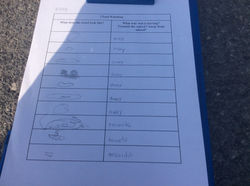
We also used means of nonverbal communication, such as the piece of paper, see the picture attached, to record our data from our observations. During this time, the kiddos were in partner groups and observed the sky and clouds outside. Throughout this time, I went around and asked the kiddos what they were observing. While asking was verbal, I was able to look around and see what they were collecting as data on their information sheets.
In the future, I hope to use a lot more media communication techniques.
I have learned through my time teaching that communicating effectively is one of the most important things a teacher can do, be that it with the students, their parents, or other teachers/staff. While I know I can still improve on this aspect, I know that I have come a long way since last fall and even in the spring.
I use verbal, nonverbal, and media communication techniques with the students daily. Verbally, I communicate directions throughout the day, and nonverbally I show them what I am expecting from them based on facial expression and body language, as well as showing them in the morning to get to work the same way I am, be that me preparing for the day or by being on my laptop, preparing something for them. Usually when I'm teaching math, I use the SmartBoard to tell students what page to go to in their workbooks or how far to go along on the activity. The SmartBoard is a great way to communicate through media and technology in other ways, too. I was able to use the SmartBoard to write problems down and have the students help me solve them.
Another way I use verbal communication is through emails and texts with my mentor, my supervisor, and other staff at the school. I have email correspondence to the tech coach as well as have emailed the technology person for Standing Stone about different apps and what the kids should and shouldn't use.
Go Math! Chapter 2 Review Centers
Science Methods Lesson

Go Math! Chapter 2 Cooperative Learning
 |
|---|
 |
 |
 |
 |
 |
 |
 |
 |
 |
 |
 |
 |
 |
 |
 |
 |
 |
 |
 |
 |
 |
 |
 |
 |
 |
 |
 |
KLEWS Chart from Science Methods Class Lesson
Pre-Assessment from Science Methods Class Lesson